Africa's New Blue Ocean. See our 2023 outlook. Download PDF

AFCFTA The Vaccine to Redeem and Propel Africa Post COVID-19

As the world continues to grapple with the effects of the Covid-19 pandemic, the year 2021, has commenced with the African Continental Free Trade Agreement (AFCFTA) becoming operational. The start of the AfCFTA is one of the most important steps made by Africa in its existence and creates a new direction that shakes the long effects of colonialism and foreign exploitation. Africa matches forward with confidence on a journey to economic independence which is the final struggle to liberation. Africa has an opportunity to fully achieve its potential by taking full advantage of the AFCFTA by allowing Africans work with fellow Africans. The effects of Covid 19 now present Africa with an existing opportunity to redeem its self and that of its people by fully embracing the advantage created by a 2 trillion US Dollar market with 1.2bn people. The start of the AfCFTA means business opportunities for millions of our people and creates new value chains for SME’s, leveraging the quest for industrialization.

The commencement of the AFCFTA provides fresh impetus for African entrepreneurs to enter new markets and provides an opportunity for the continent to enter into a new era of industrialization because trade will be duty free. Africa is in position to start trading on preferential terms with 54 countries out of 55 having signed and majority having ratified the AFCFTA to fulfill the objective of the ‘‘AFRICA WE WANT 2063 AGENDA’’. The starting of AFCFTA trading should now create an opportunity for us to harmonize our e commerce agenda and issues in Intellectual Property and competition law. The African trade gateway hub to be developed by the Afriexim bank should help traders across Africa access business opportunities and conduct due diligence on business across Africa as well as access credit from the Afriexim bank to support business and cross border trade.  The Afriexim bank is offering 40billion US Dollars with the start of the AFCFTA this year to support the implementation of the Africa Continental free Trade Area and will work with at least one bank to support intra African trade in each African Country. This should create opportunities for the financial sector in Uganda to support the AFCFTA and Africa’s industrialization Agenda.  According to the Economic commission for Africa, the AFCFTA will accelerate intra Africa trade by 25 to 35 % equivalent to 35billion dollars which will reverse the effects of covid 19 on the continent. The call by the Economic Commission for Africa to support countries develop implementation strategies for the AFCFTA should be welcomed by the Ugandan government as soon as possible in its agenda of taking advantage of the AFCTA.

Continued democratic inconsistences and human rights violations subjugate Africa’s efforts and struggle to redeem itself from economic subjugation and the effects of colonialism. We can no longer blame foreign subjugation. The future is in our hands.

The “Big” Deal About The Mining Bill: Key Highlights

Currently, the Mining Act 1940 (Chapter 306 of the Laws of Kenya) regulates all mining activities in Kenya. The legislative proposal giving rise to the Mining Bill was recently submitted by the Cabinet Secretary for Mining. Once the Bill is assented to by the President, it will repeal the existing legislation relating to mining and it will establish a new legal framework for the management of mineral resources in Kenya.

Following the promulgation of the new Constitution, more focus was brought under Article 69 to ensure sustainable exploitation, utilization, management, and conservation of the environment and its natural resources. Whilst focusing on the above, the Constitution requires the State to ensure there is equitable sharing of accruing benefits. Other than the constitutional need to amend the Mining Act accordingly, it is over 60 years old which makes it outdated as it fails to accommodate both technological and economic advancements.

Technological developments have made it possible for information to be shared electronically across the world, and most importantly, make payments and trade on a common virtual platform. The Bill therefore embraces technological advancements by providing for a computerized mining cadastre and registry system which will include an online transactional facility to enable applications for the granting and renewal of mineral rights to be submitted online.

Policies to bolster economic growth have also been incorporated into the Mining Bill and a good example is local content. “Local content” is defined as the added value brought to a host nation (and local and regional areas in that country) through activities such as oil exploration, and mining among others.

Principal objectives of the legislation

State Corporation

It specifically establishes a mining corporation (previously not in existence), that will be the investment arm of the government in respect to minerals. The corporation’s functions among others will be to engage in mineral prospecting and mining. The corporation will also have a chief executive officer who will be recruited by the corporation and will be responsible for the day-to-day administration and management of the affairs of the mining corporation.

The Board

The mining corporation will also have a board whose chairman will be appointed by the President, the Principal Secretary responsible for mining or a representative; the Principal Secretary responsible for the National Treasury or a representative; the Principal Secretary responsible for trade or a representative and four other persons not being employees of the corporation, of whom not more than two shall be public officers. The introduction of this corporation will go a long way in bolstering the economy because it will ensure that the proceeds made by mining corporations are invested back into the country.

Mineral and Metals Commodity Exchange

The Mining Bill also aims to facilitate efficiency and security in mineral trade transactions by making provision for the Cabinet Secretary to establish a mineral and metals commodity exchange. Unlike before, the geoscience information will also be recorded and made available to the public upon request. A minerals and metals exchange is a market where various minerals and contracts based on them (derivative products) are traded. The exchanges usually trade future contracts on the minerals-such as trading contracts to receive gold in a certain month at a certain price. With such an exchange in place, the middlemen and other intermediaries who make money out of speculation are kicked out of the mineral value chain. The aim of this would be to lead the region in trade despite not having all the minerals and metals.

Mining Tribunal

An important element to be highlighted is the introduction of the mining tribunal. Previously, disputes would be lodged with the Commissioner of Mines and Geology but the Mining Bill provides for an ad hoc tribunal to be set up by the cabinet secretary in consultation with the Chief Justice.

New Offices

The Mining Bill has also done away with the office of the Commissioner whose primary duty was to ensure the provisions of the previous Act were followed. The Mining Bill states that the Cabinet Secretary for mining will be responsible for its general administration. It gives him extensive powers to make regulations to prescribe the procedure for consideration of applications made under the Bill and also to negotiate, grant, revoke, suspend, or renew mineral rights. Another addition is the Directorate of Mines and the Directorate of Geological Survey both of whom have their specific functions listed in the Mining Bill.

However, the Cabinet Secretary is empowered by the Mining Bill to establish additional directorates if need be. This change could either remove the previous directorates listed below or be amalgamated altogether:

  1. Directorate of Mineral Management and Regulations;
  2. Directorate of Geological Surveys;
  3. Directorate of Mineral Promotion and Value Addition;
  4. Directorate of Mine Health, Safety and Environment;
  5. Directorate of Resource Surveys and Remote Sensing; and
  6. Directorate of Corporate Affairs.

Mineral Rights

Another highlight in the Mining Bill is that the requirements of obtaining a mining right have been categorized into those needed for a natural person, and for a corporate entity. The current Mining Act prohibits a company from being granted a prospecting right; it only states that it could be granted to an individual as an agent of the company. Additionally, the provision on conditions to be fulfilled for any applicants is lengthy and makes it difficult to easily construe the conditions needed.

Furthermore, the Mining Bill introduces large and small scale operations which will determine the mineral right to be granted. The licences and permits granted to a mineral right holder engaged in large scale operations will include a prospecting licence, a retention licence, or a mining licence. On the other hand, those involved in small scale operations will include a prospecting permit or a mining permit. Large scale operations and small scale operations will be designated by the Cabinet Secretary. It should be noted that the Mining Bill expressly states that permits under small scale operations will only be given to Kenyan citizens or a body corporate owned by Kenyan citizens.

The Bill has also provided for rights granted on both private and community land which was not there before.

       i. Private Land

Mineral rights on private land will only be granted to applicants if they have express consent from the owner and this will be through a legally binding agreement which allows prospecting or mining operations to take place or for an agreement concerning adequate compensation.

       ii. Community Land

Mineral rights on community land will be given to applicants if they obtain consent from the authority in charge of administering such land or the National Land Commission in relation to community land that is alienated.

Mineral Agreements

The Mining Bill also introduces mineral agreements which may be entered into, by a prospecting licence holder and the Cabinet Secretary with respect to any matter related to operations under the licence. Although the Mining Bill does not make it mandatory, it states that the Cabinet Secretary will prescribe the type of operations that will be subject to such an agreement.

Local Content

As mentioned in the background of this article, local content is one of the elements introduced by the Mining Bill. Though local content has not been expressly defined in the Mining Bill, the Bill does ensure its provision by requiring mineral right holders to submit to the Cabinet Secretary a detailed programme for recruitment and training of Kenyan citizens in a bid to ensure the transfer of skills and capacity building for citizens. There is also an obligation for mineral right holders to source for materials and services. Another obligation is one to give employment preference to Kenyan citizens. The spirit behind these provisions is similar to the local content provisions in both the Energy Bill and the Petroleum, Exploration & Development Bill of 2015. The Mining Bill gives the Cabinet Secretary powers to issue further policy guidelines to give further effect to these requirements.

Government Participation

Where the mineral rights are for large scale operations or mining operations relating to strategic minerals, the Mining Bill stipulates that the State will acquire 10% free carried interest in the share capital of the right in respect of which financial contribution will not be paid by the State. There will also be a limitation on capital expenditure for the mineral right holders but this will be prescribed by the Cabinet Secretary. Where the holder’s capital has exceeded the limit within 4 years of obtaining the licence, there will be a requirement to offload at least 20% of its equity at a local stock exchange.

To whom does the legislation apply?

The Mining Bill will apply to the Ministry of Mining headed by the Cabinet Secretary, the mining corporation and its Board, the Directorate of Mines and Geological Survey, applicants of mineral rights, mineral right holders, and the mining tribunal. All these bodies are established by the Mining Bill except for the Ministry. With regards to the substantial minerals, the Mining Bill has specified in its First Schedule the following categories; construction and industrial materials; precious stones; precious metal group; semi-precious stones group; base and bare metal group; fuel mineral group; and gaseous minerals. Reference should be made to the first schedule of the Bill to see where the specific mineral is categorized. The Cabinet Secretary in charge of mining may, from time to time, by notice in the Gazette, amend the First Schedule. However the Mining Bill will not apply to matters relating to petroleum and hydrocarbon gases.

How does the legislation apply?

The Mining Bill will repeal the entire Mining Act (Chapter 306) once it is assented and comes into force.

Future review/revision and steps required in regard to the legislation

In order for the Mining Bill to be effective, it needs to be accompanied by regulations and policies. Most of the provisions discussed above anticipate for the Cabinet Secretary to provide policy guidelines. The better avenue would have been for the drafters of this Bill to provide anticipatory regulations that once implemented, would be subject to change by the Cabinet Secretary if need be. Regulation is of critical importance in shaping the welfare of economies and society. The objective of regulatory policy is to ensure that legislation works effectively, and is in the public interest.

Field Notes & Insights: Changes Local Content And Local Particpation Regime In The Upstream Sector

In over a decade of commercial oil production in Ghana, the government and policy makers in the energy sector have been steadily working on the right formula to achieve that regulatory sweet spot where direct foreign investment converges with Ghanaian participation and content. The core objective has been to achieve the desired levels of state-of-the-art technology and technical know-how, technology and skills transfer, optimal in-country spend, value addition, job creation, and competitiveness in our upstream sector. The legal framework for Ghanaian content and participation in upstream activities started out originally as contractual commitments in petroleum agreements to employ and train Ghanaians, and to give preference to materials, services and products produced in Ghana which meet international industry standards. This has evolved into regulations – the Petroleum (Local Content and Local Participation) Regulations, 2013 (L.I. 2204) which has recently been amended by the Petroleum (Local Content and Local Participation) (Amendment) Regulations, 2021 (L.I. 2435). The purpose of these regulations is to further enhance and expand the opportunities for Ghanaian participation and value creation in the sector via three thematic areas: a redefinition of the indigenous Ghanaian company (IGC); alternative business arrangements for collaboration with foreign entities and a defined scope of services and goods to be reserved for supply solely by IGCs. This article highlights two of these new regulatory changes and the opportunities they present to the market.

Background to Local Content and Local Participation Regulations

The National Energy Policy 2010 (NEP 2010) highlighted “the need to build the necessary human, financial and technological capacity of Ghanaians to be able to participate fully in the petroleum industry”. The aim was to stimulate accelerated economic growth, job creation, poverty reduction and general prosperity among the Ghanaian people through the oil and gas industry. The NEP 2010 further concluded that: “[t]his can be achieved through a well formulated Ghanaian local content and participation policy and regulatory environment…”. This resulted in the enactment of L.I. 2204 with prescribed thresholds for local participation at the contractor level and, minimum local content and in-country spend at the supplier/subcontractor level.

Historically, the legal framework for upstream operations has always emphasised the employment and training of Ghanaians by foreign participants in the sector. However, under L.I. 2204, the indigenous Ghanaian company (IGC) was formally identified as a defined category of service provider through which the local content and local participation goals may be realised. Initially, the IGC was an entity incorporated in Ghana with a minimum of 51% Ghanaian equity holding, 80% Ghanaian executive and senior management staff and 100% Ghanaian non-managerial staff. To help achieve the local content and participation objectives of the NEP, L.I. 2204 afforded IGCs specific advantages over joint venture companies (JVCs) and international oil companies (IOCs) including:

(a) entitlement to preferential treatment in the award of petroleum agreements and petroleum licenses;

(b) the opportunity to own up to 5% in all petroleum interests granted by the State;

(c)  entitled right to a 10% price preference in the award of contracts for the provision of goods and services for upstream operations;

(d)  the right to a minimum of 10% shares in all companies authorised to supply goods and services in the sector; and

(e) the exclusive right to supply specific services in the sector such as legal, financial and insurance services.

The amendment under L.I. 2435 is intended to maximize Local Content & Local Participation in the energy sector in accordance with the National Energy Policy 2020. The key areas are the expanded Ghanaian participation in IGCs and the new mechanisms for collaboration with foreigners which have been analysed below.

  1. a) Expanded Ghanaian Participation in IGCs

Under L.I. 2435, an IGC has been redefined to require incorporation in Ghana with a 100% Ghanaian equity holding, 80% Ghanaian executive and senior management staff and 100% Ghanaian non-managerial staff. This new regime presents a shift from majority Ghanaian ownership to full Ghanaian ownership. The IGC is now truly Ghanaian in substance and form with unprecedented access to various opportunities in the sector, notably the exclusive right to provide an expanded range of services and goods, including electrical equipment and materials, industrial and domestic gases, network installation and support services, ship chandelling, warehousing, etc. With the recent change in the IGC shareholding structure, former IGCs with foreign interests which hitherto could benefit from the above listed advantages will now give way to wholly Ghanaian owned businesses. This may lead to an increase in participation of IGCs in the various roles as contractor party and service provider as discussed below.

  • The IGC as a contractor party

Following the enactment of L.I. 2204, about 11 out of the 14 petroleum agreements awarded by the State include IGCs as contractor parties. This new IGC regime seeks to better protect Ghanaian interests and expand the opportunities for Ghanaian participation by eliminating the possibility of indirect foreign interests in the 5% participation interest reserved for Ghanaians. With this key change, Ghanaian owned businesses have an enhanced opportunity to increase their investments, build capacity, and optimize technology and skills transfer to grow the upstream sector. The change also presents an opportunity for IGCs to prepare their businesses, forge partnerships, pool resources and scale up to attract the funding required to cover the IGC share of capital expenditure required for petroleum operations.

  • IGC as a service provider

Currently, the Petroleum Commission has registered over 1600 IGCs, with approximately 600 actively operating in the service segment of the upstream sector. Under L.I. 2204, IGCs are entitled to first preference in the bidding process for the supply of goods and services.  Additionally, during a bidding process, an IGC cannot be disqualified exclusively on the basis that it did not offer the lowest price. Where the difference between the total value of the bid of a qualified IGC and the lowest bid does not exceed 10% of the lowest bid, the contract must be awarded to the IGC. Essentially, an IGC should be prioritized over a JVC in a tender where the IGC’s bid price is at most 10% higher than the quote from the JVC. This price preference is aimed at maximising local content in all aspects of the industry value chain to boost the capacity and competitiveness of Ghanaian owned entities in the upstream market. Today, with the new mandatory shareholding structure, many of the existing IGCs will lose their IGC status and the right to the above-mentioned statutory benefits. These advantages are now available to only Ghanaians. This will lead to the exit of former IGCs with foreign interest or their transformation into wholly owned Ghanaian entities which will create room for more wholly owned Ghanaian businesses to participate in this competitive market segment.

  1. Mechanisms For Collaboration with Foreigners

As previously stated, under L.I. 2204, foreign owned businesses may only supply goods and services in the upstream sector in association with IGCs, via a registered JVC where the IGC holds a minimum of 10% shares. The impact of the mandatory requirement for collaboration between foreign owned businesses and IGCs in the upstream service segment has been revolutionary in promoting capacity building through knowledge and skills transfer to Ghanaian entities from their more experienced foreign partners. Although some JVCs have, for a myriad of reasons, been unsuccessful, they are in the minority. Through these collaborations, many Ghanaian entrepreneurs have seen radical growth in their capacity in their core area, as well as new insights and expertise in other emerging areas as a result of unprecedented access to greater resources, technology and finance. Many Ghanaian partners in JVCs now have access to new markets and have been able to scale up in spite of their limited capacity, giving them competitive advantage to generate economies of scalability.

In spite of the success of the JVC structure under LI 2204, experience over the 9 years of implementation has highlighted areas for improvement. The intervention by the Ministry of Energy and the Petroleum Commission with the introduction of alternative models and structures for collaboration under LI 2435 is most timely and will ensure a wider berth for knowledge and skills transfer in the upstream sector. The alternative structures provided under LI 2435 have been discussed below.

The Alternative structures

L.I. 2435 authorizes the use of channel partnerships and strategic alliances as complementary options to the JV structure in the provision of goods and services in the upstream sector. A channel partnership is usually established between a manufacturer or producer with another company such as a reseller, service provider, vendor, retailer or agent, to market or sell their services, products or technologies. A strategic alliance on the other hand refers to an arrangement between two or more companies to share resources to undertake a specific mutually beneficial project, while each party retains their corporate independence.

With the establishment of these alternative structures, the JV ceases to be the only channel through which both an IGC and a foreign entity can collaborate to provide services in the industry. The Petroleum Commission is mandated to exercise a discretion and give the appropriate direction to enable a foreign entity or an IGC provide services in Ghana through such arrangements where it is of the opinion that “a channel partnership or strategic alliance will deepen local content and local participation and maximize technology transfer to the IGC”.

The introduction of these alternative structures will allow more flexibility and efficiency in service delivery in the upstream sector. Through channel partnerships and strategic alliances, IGCs and their foreign partners may share resources to execute defined supply/service scope while each party retains their independence with no obligation to establish and register a company. Parties in channel partnerships and strategic alliances are able to bypass the strict formal requirement for setting up a JVC such as the incorporation of Ghanaian limited liability companies by both the IGC and its foreign partner and the registration of the JVC with the Ghana Investment Promotion Centre (GIPC). The partners are able to maintain their existing corporate structures while managing their roles and responsibilities through contractual arrangements.

These new regulations provide a tremendous improvement on the existing framework for local content and open up the upstream service/goods supply space with unprecedented opportunities for more IGCs to participate in the sector, improve their product offerings and grow their skills and capacities.

Conclusion

The new IGC requirements and the introduction of alternative structures present greater opportunities for Ghanaians to benefit from the upstream oil and gas industry. Whilst the regulations provide the framework, the full potential of this new regime will not be achieved unless Ghanaian participants adopt the right legal structures and contracts for their engagements in oil and gas operations. This will require seeking and offering the right legal advice, not only in setting up of their businesses, but in the drafting and negotiating of contracts.


Delving deeper: A closer look at local content in Kenya’s growing mining sector

Kenya intends to overhaul its mining laws currently contained in the Mining Act (Cap 306 of the Laws of Kenya) by passing the Mining Bill, 2014 that is currently being debated in Parliament. The Mining Bill, if passed in its current form, will introduce a range of new provisions among them being those on local content.

Principal objectives of local content regulations in the mining sector

Currently, the Mining Act does not make provision for local content. The rationale behind local content in the proposed Mining Bill lies in the need to develop the economy of a host nation and its surrounding region through mining activities.

(a) Local Equity Participation

The Mining Bill states that where a company whose planned capital expenditure is over the prescribed limit it shall, within 4 years after obtaining a mining license, offload at least 20% of its equity at a local stock exchange. It should be noted, however, that the Cabinet Secretary may extend the required period if he deems it fit after consulting with the National Treasury.

(b) Preference for Local Product

The Mining Bill requires mineral right holders who are in the conduct of prospecting, mining, processing, refining, and treatment operations, or any other dealings in minerals, to give preference to the maximum extent possible to:

  • materials and products made in Kenya;
  • services offered by Kenyan citizens; and
  • companies or businesses owned by Kenyan citizens.

(c) Employment

As a general requirement, mineral rights holders will be under an obligation to give preference to Kenyan citizens when it comes to employment. The Mining Bill provides that before one is granted mineral rights in Kenya, one will be required to submit for approval to the Cabinet Secretary responsible for mining a detailed programme for the recruitment and training of citizens of Kenya. This is aimed at ensuring skills transfer to and capacity building for the citizens.

The Cabinet Secretary will be required to make regulations to provide for:

  • the replacement of expatriates;
  • the number of years such expatriates shall serve;
  • the number of expatriates per capital investment; and
  • the collaboration and linkage with universities and research institutions to train citizens.

It is important to note that the Bill has categorized mining activities into large-scale operations and small-scale operations. Mineral rights for small-scale operations will only be granted or be entitled to Kenyan citizens or a body corporate wholly owned by Kenyan citizens. On the other hand, when it comes to large-scale operations, a holder of a mineral right will be required to:

  • only engage non-citizen technical experts in accordance with such local standards for registration as may be prescribed in the relevant law;
  • work at replacing technical non-citizen employees with Kenyans, within such reasonable period as may be prescribed by the Cabinet Secretary in charge of mining;
  • provide a linkage with the universities for purposes of research and environmental management;
  • where applicable and necessary facilitate and carry out social responsibility to the local communities; and implement a community development agreement

It is important therefore that interested parties confirm from the outset whether their mining activities would fall under large-scale or small-scale operations in order to be in a position to ensure compliance as the requirements for approvals in each of these operations are different.

Unsolicited Solutions to Public Problems

It is the prime responsibility of the Government to provide public infrastructure and related services to address public needs. However, in most developing countries including Ghana, there is a huge gap between infrastructure needs and infrastructure delivery by Government. One reason for this is inadequate resources for Government to use to provide needed infrastructure. One option to deal with this is Government engaging private sector to deliver such public infrastructure and related services. Public Private Partnerships (PPPs) have become one of the most preferred options for engaging the private sector to support Government in the provision of public infrastructure and related services.

PPPs simply refer to any form of contractual arrangement by which public sector entities partner with private sector entities to deliver public infrastructure and related services usually over a long-term with the private sector partner assuming substantial risk[i]. In order to engage a private sector partner, Government prepares the project through the conduct of feasibility studies and prepares procurement document, then invites proposals for the projects from interested private entities using a competitive procurement process. However, private parties can also submit proposals without any request from Government to provide public infrastructure and related services through unsolicited proposals.

A good number of people reading this article may have come across a brilliant and innovative initiative by a Small or Medium-scale Enterprise (SMEs) and thought that some major national infrastructure gap or required public service would be filled or provided if the initiative was adopted by Government. However, for many of such SMEs or startups, the thought of partnering with Government is confusing and daunting.

This article breaks down the process for unsolicited proposals under the PPP Act for easy understanding and makes a case for SMEs to be proactive in solving public infrastructure problems through such unsolicited proposals.

Unsolicited Proposals

Under Ghana’s PPP Act, an unsolicited proposal is a proposal made by a private party to undertake a partnership project and is submitted at the initiative of the private party rather than in response to a request for proposal by a public sector entity. Thus, an unsolicited proposal is considered a private sector-led proposal.

Preliminary requirements for PPP Projects Initiated by Unsolicited Proposals

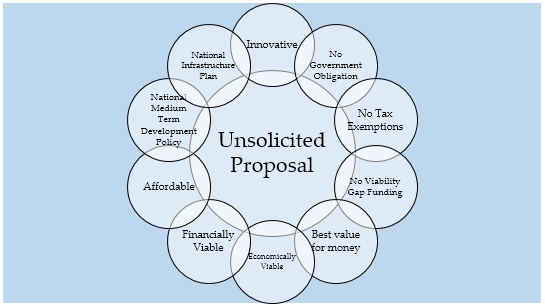
There are three (3) requirements for PPP projects initiated through unsolicited proposals. These are:

  1. The PPP project must be innovative and not place an onerous obligation on Government.
  2. The PPP project must be a project that is not already part of the Medium Term Development Plan of the public institution that the private entity is seeking to partner with; and
  3. The PPP project proposed must be consistent with the overall National Infrastructure Plan.

Figure 1 Summary of Preliminary Requirements

Even though dictated by law, the writer is of the view that it should be possible for unsolicited proposals to be submitted for projects in the Medium Term Plan and National Development Plan. The focus must be on the innovation that the proposed solution offers. This avoids instances where projects, though urgently needed, are never implemented for many years due to lack of resources from Government. Government should be open to consider unsolicited proposals.

Notably missing from the requirements above is the fact that the scale of the product or services rendered by the private party is not a condition precedent for consideration of a PPP project through unsolicited proposals. Thus, there is an opportunity for SMEs or startups to submit unsolicited proposals under the PPP Act.

Once the above criteria are met, the PPP Project will go through processes prescribed under the Act including a feasibility study before final approval by the relevant government entity that will undertake the project.

Advantages of Unsolicited Proposals

The use of unsolicited proposal to execute public project confers a number of advantages on the private party, Government and the public including:

  1. For the private sector, PPP projects through unsolicited proposals provide a great platform for private sector companies to see their innovative solutions to complex national problems roll out on a nationwide scale.
  2. Also, the private sector and public entities avoids lengthy procurement processes to implement projects more quickly. Government is able to catch up with the ever increasing demand for infrastructure and related services through the adoption of a faster procurement process that is well balanced with ensuring value for money and related issues.
  3. For Government, the projects that Government does not have the needed resources to implement, can be implemented through unsolicited proposals especially those of a commercial nature for which user changes make economic sense. The Government is able to focus limited resources on other projects mostly of a social and non-commercial nature.
  4. Unsolicited proposals are a good avenue for overcoming the Government’s lack of (financial and human) to identify, prioritize, prepare and procure projects.
  5. Unsolicited proposals enable the Government to address its inability to plan and fund necessary infrastructure development.
  6. Government is able to tap into the private sector’s innovation and knowledge to identify value-for-money project solutions through the adoption of unsolicited proposals.
  7. The public gets the needed infrastructure and related services with all its attendant economic and social benefits.

Challenges with Unsolicited Proposals

In spite of the many benefits of unsolicited proposals to both Government and the private sector, PPP projects initiated through unsolicited proposals come with challenges including:

  1. Perception of Corruption: Perhaps, the most notable among such challenges especially in this part of the world, is the challenge of balancing the need to address infrastructure needs with the private sector’s motive to make profit and the attendant adverse perception of corruption.
  2. Unsolicited projects can divert government attention from systematically planning infrastructure, especially in developing countries where there is a plethora of infrastructure needs each screaming for immediate attention. This is because, while Government may have a holistic approach to infrastructure plans, a private entity has no such objective.
  3. There is also the possibility of not getting value for money since the process for unsolicited proposals is less competitive compared with a Government invitation to interested parties to submit proposals.
  4. Due to profit motive of the private sector, the high rate of return may affect financial viability of projects. To deal with this, the private party may request for viability gap funding, tax exemption and other government financial support.
  5. User Affordability: related to the above, user charges proposed by the private party may be high and above acceptable levels for the general public or users of the infrastructure and related services.

Recommendations

To overcome the challenges, the following are recommended:

  1. Government’s clear policy for unsolicited proposals must provide steps and timelines for management of unsolicited proposals, covering minimum submission requirements; reimbursement and protection of intellectual property; procedures for introducing competition and reward systems and eligibility and types of Government support, if any. The PPP Act has attempted to address this by providing various checks and balances with respect to the procedure for the approval of unsolicited proposals. However, there is an absence of clear guidelines for PPP projects based on international best practices. Hopefully, the enactment of the PPP regulations would fill this gap.
  2. Government must build institutional capacity particularly for public sector agencies with the requisite skill for managing unsolicited proposals including; conducting feasibility; designing and implementing clear guidelines for the assessment of fiscal risks and liabilities; evaluating proposals, drafting and negotiating PPP contacts as well as monitoring implementation. Where the required expertise is absent in-house, transaction advisors should be engaged.
  3. Government agencies must ensure that they are getting value for money. If more than one private sector entity propose similar PPP projects, the proposals must be vetted objectively. It is expected that the Public Private Partnership Regulations would outline a procedure for unsolicited proposals that will balance the need to strictly vet unsolicited proposals with the goal of encouraging innovative projects from the private sector to address national issues.

Conclusion

A fast paced development is dependent on both private sector initiative and government effort. The private sector has been touted as the engine of growth. Unsolicited proposals offer a great opportunity for private sector entities to propose and undertake projects that not only fill the infrastructure gap, but also accelerate development. While government must embrace this option and build institutional capacity and provide clear guidelines that encourage private sector parties to take up the opportunities, the private sector must proactively begin to put their innovations to use by proposing solutions to public entities and implementing those proposed solutions in partnership with public entities not only for their mutual benefit, but for a broader public good and development.